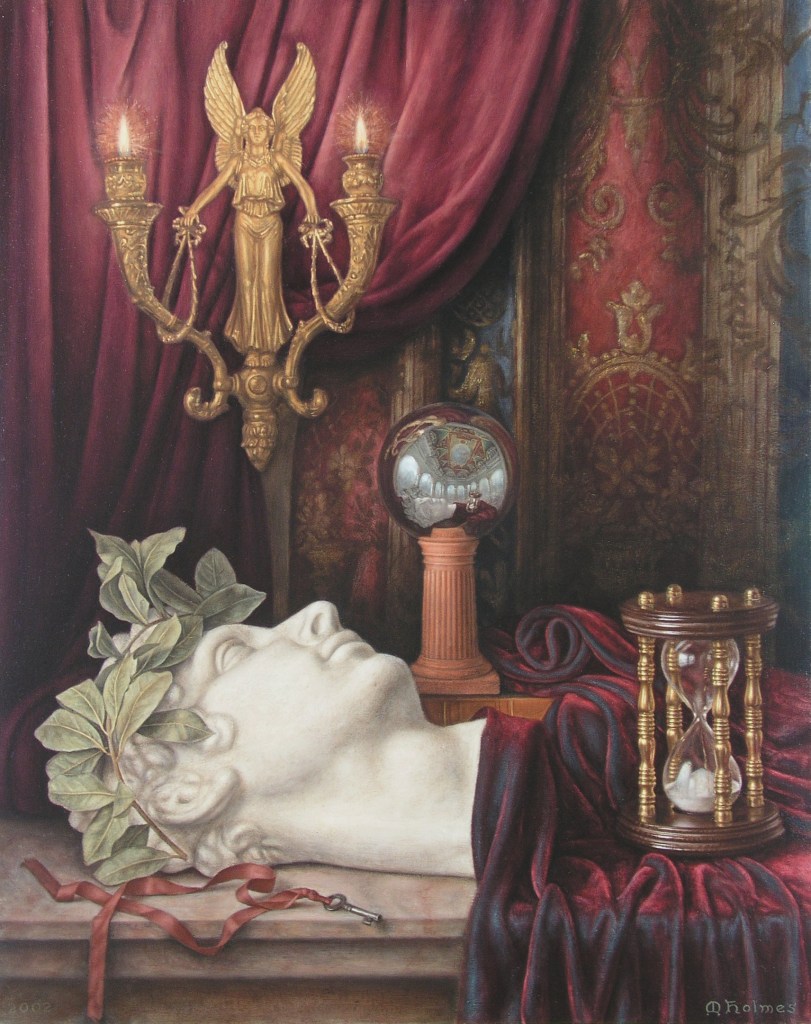
“Vanitas is a recurring title of many artworks, signifying the most elemental aspect of the human condition: mortality. So goes the lament in the Book of Ecclesiastes, “Vanity of vanities, . . . all is vanity.” As a thematic genre, a vanitas (derived from a Latin word that means “empty”) is a reflection on the ephemeral nature of all earthly beauties and endeavors. It is one of the oldest themes in still life painting and appeared frequently during the Golden Age of painting in the 16th and 17th centuries. Art historians refer to the symbolic content of items in a picture as iconography. The subject of a vanitas may typically be recognized by the presence of a skull set amidst attributes of worldy pleasures and glories pertaining to their life.
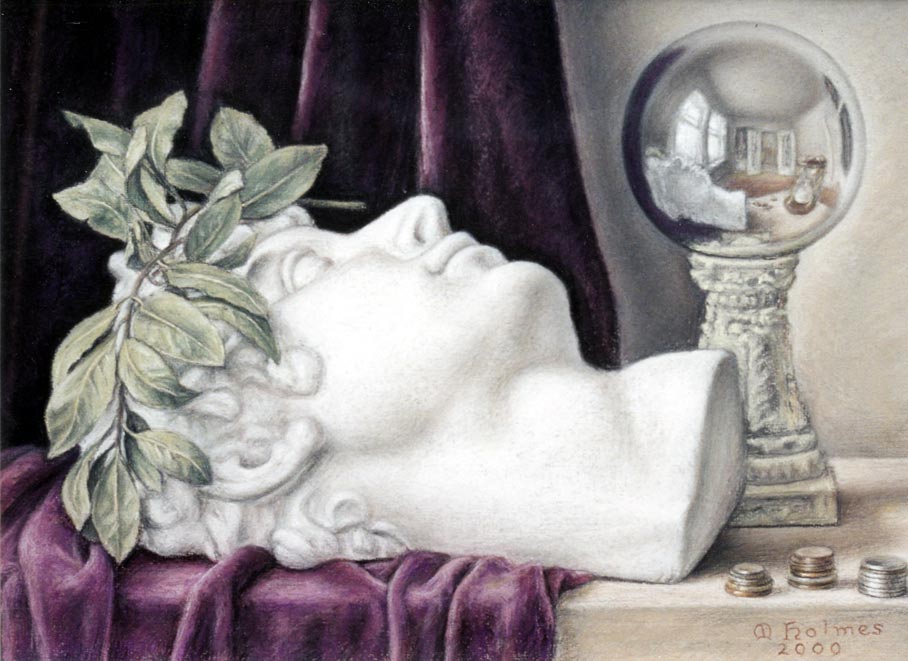
“In the picture I have entitled Vanitas, a plaster cast is substituted for the usual skull. The latter generally conveys the notion of decay, but the recumbent cast suggests more the idea of being asleep. Around the head is a “crown” of dried and faded laurel leaves, intended to represent worldly honors. The hourglass is meant to signify time. In this case it has run out. Two elements, however, imply that this present life is not “all there is.” The sconce with the angelic light bearer above represents the idea of the heavenly or spiritual. The gazing ball reflects another dimension, the idea of an unknown realm beyond the material world. (The room reflected in the sphere is actually the Hall of the Doges in the Davenport Hotel one mile from where this was painted). The key on the table suggests a lock—possibly to a door—but whatever it goes to remains a mystery. Nevertheless, hope remains that what has been locked may be opened again.
“It is my view that works of fine art are objects of contemplation, wherein the viewer is invited to consider what the artist has chosen to present. According to my personal philosophy of art, the goal is not necessarily to instruct or offer conclusions but rather to suggest avenues of thought for the viewer to explore. I am also intrigued by the possibility that there may be such a thing as elemental or universal symbolism, where any viewer can grasp the significance without requiring an explanation, though so far this may only be speculation.”
Melville Holmes

 Melville Holmes